PLC/DCS Troubleshooting & Control Logic Interpretation

- Description
- Curriculum
- Reviews
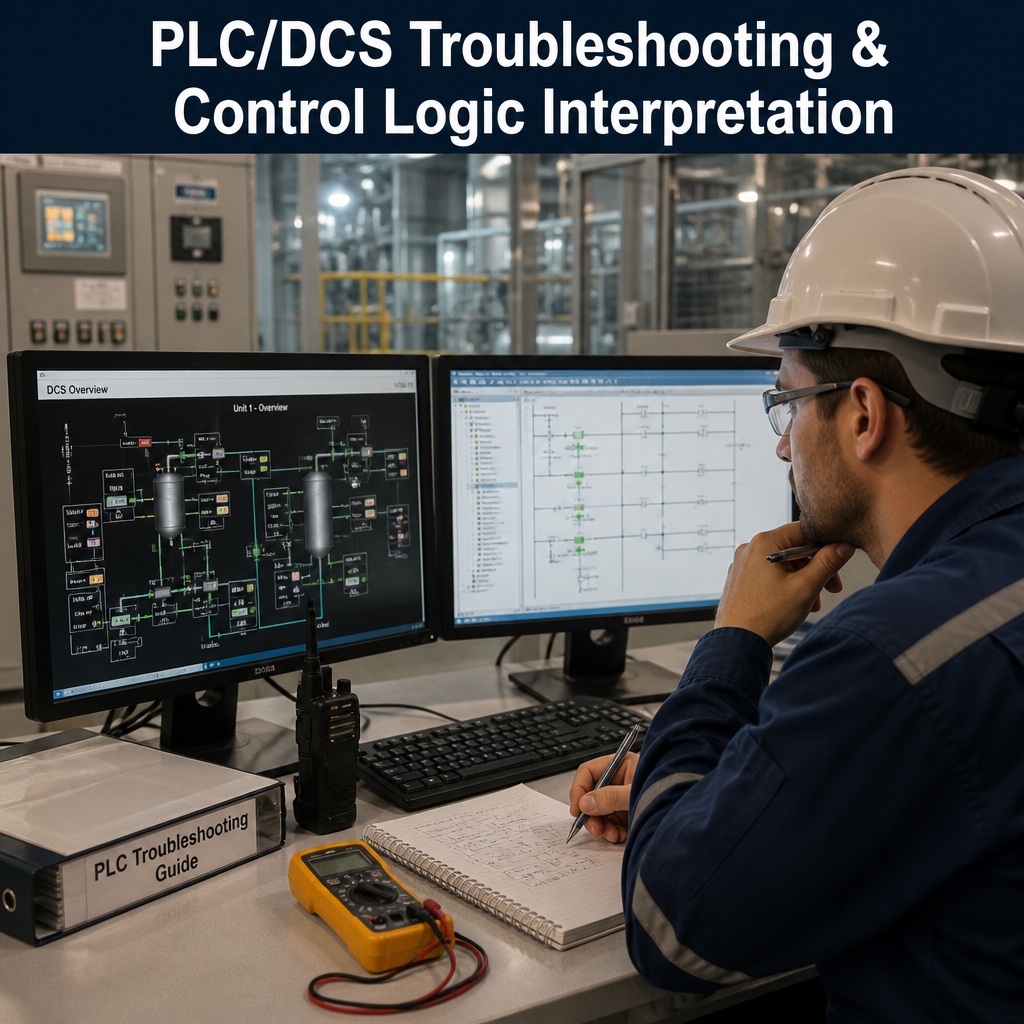
PLC/DCS Troubleshooting & Control Logic Interpretation
Can you determine why a control system is not behaving as expected—and identify the most useful next check?
This assessment uses realistic industrial scenarios to evaluate your ability to interpret control logic, trace signals, investigate sequence failures, and distinguish field-device problems from controller, communication, or configuration issues.
Assessment details
• Questions: 30 single-choice questions.
• Answer options: Four per question, with one best answer.
• Recommended time: 60 minutes.
• Level: Practitioner, with selected advanced diagnostic scenarios.
Topics covered
• PLC/DCS architecture and diagnostic boundaries.
• Digital and analog I/O interpretation.
• Boolean logic, permissives, and interlocks.
• Sequences, timers, and operating modes.
• DCS control loops, alarms, and event timelines.
• Structured troubleshooting and controlled restoration.
Instructions
Read each scenario carefully and use the stated signal definitions, operating modes, logic conditions, and execution rules.
Distinguish a command from field actuation, displayed information from verified equipment condition, and an observed alarm from a confirmed cause.
For calculation and logic-tracing questions, check units, input states, timing assumptions, and sequence order. A basic calculator may be used.
When several explanations remain possible, select the check that best distinguishes them. Consider process consequences and authorization before actions that could change equipment behaviour.
Complete the quiz independently to obtain a useful indication of your development needs.
Your results support focused learning and supervised practice. Successful completion does not independently verify practical programming competence or authorize changes to operating control or safety systems.