
Why Technical Experience Alone Is Not Enough to Prove Competency
In technical industries, experience matters.
An engineer who has spent ten years maintaining rotating equipment, commissioning electrical systems, troubleshooting instrumentation failures, or managing industrial projects will naturally develop knowledge that cannot be obtained from textbooks alone.
Yet there is an important distinction that professionals often overlook:
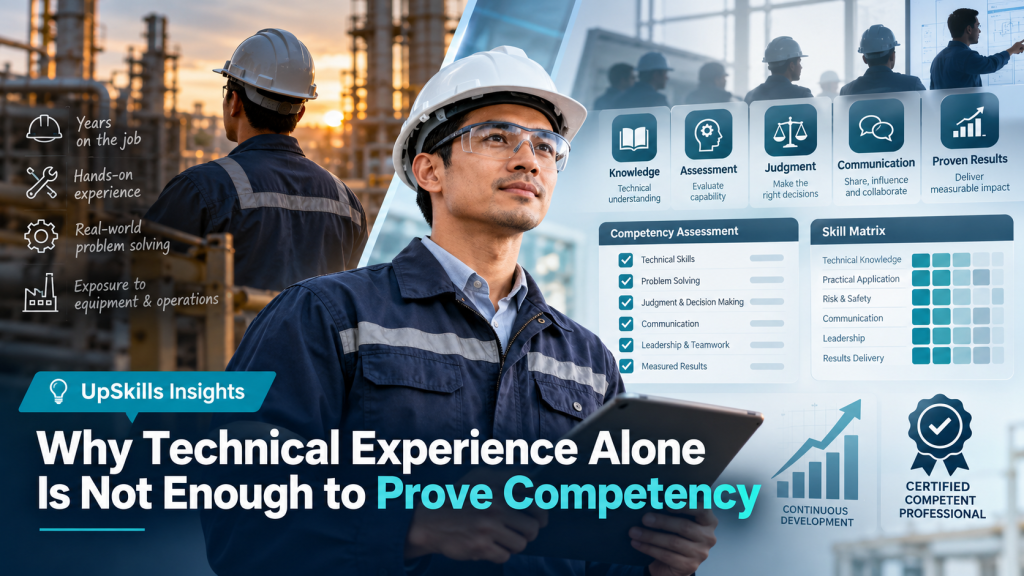
Experience is evidence that you have been exposed to work. Competency is evidence that you can perform that work effectively, consistently, and according to an expected standard.
The two are related, but they are not the same.
This distinction becomes increasingly important as organizations move toward competency-based recruitment, professional certification, structured career development, and skills-based workforce management.
For professionals, understanding this difference can determine whether years of experience translate into stronger career opportunities—or remain simply a number on a CV.
Experience Tells Us What You Have Done
Technical experience usually describes exposure.
A professional may say:
- 10 years of electrical maintenance experience
- 8 years working with PLC and DCS systems
- 5 years managing industrial projects
- Extensive experience troubleshooting rotating equipment
- Experience performing shutdown and turnaround activities
These statements provide useful information.
They indicate that the person has worked in certain environments and has likely encountered relevant technical problems.
However, experience alone does not tell us:
- how independently the person performed the work,
- how complex the problems were,
- whether the decisions were technically sound,
- whether the work consistently met applicable standards,
- whether the person understood the underlying engineering principles,
- whether the individual could repeat the performance in a different situation,
- or whether the results created measurable value.
Two people may both have ten years of experience while possessing very different levels of competency.
One may have continuously solved increasingly complex problems and taken responsibility for critical decisions.
Another may have repeated essentially the same task for ten years.
Their experience duration is similar.
Their competency may not be.
Competency Is About Demonstrated Capability
Competency is broader than knowledge or experience.
A useful way to think about competency is:
Competency = Knowledge + Skills + Application + Judgment + Behavior + Evidence
Knowledge refers to understanding principles, standards, methods, and technical concepts.
Skills refer to the ability to perform relevant activities.
Application means being able to use those skills in real working situations.
Judgment involves selecting the appropriate solution when information is incomplete or trade-offs exist.
Behavior includes communication, safety awareness, leadership, accountability, and professional conduct.
Evidence demonstrates that these capabilities have actually produced results.
This is why competency frameworks frequently evaluate professionals across several dimensions instead of simply counting years of experience.
The Problem With “Years of Experience”
Years of experience are attractive because they are easy to measure.
A job advertisement might require:
Minimum 8 years of engineering experience.
This requirement acts as a simple screening mechanism.
But years of experience are only a proxy for capability.
Consider two maintenance engineers.
Engineer A has worked for ten years performing preventive maintenance according to established procedures.
Engineer B has worked for seven years but has:
- investigated recurring equipment failures,
- redesigned maintenance strategies,
- developed predictive monitoring programs,
- led shutdown activities,
- managed contractors,
- conducted root cause analyses,
- implemented reliability improvements,
- and demonstrated measurable reductions in equipment failure.
Engineer A has more experience in terms of years.
Engineer B may have significantly stronger competency.
The difference lies in depth, complexity, responsibility, and demonstrated outcomes.
Exposure Is Not the Same as Mastery
Being present during an activity does not automatically mean a person mastered it.
For example, an engineer may have participated in several commissioning projects.
But their actual involvement could range from:
- observing commissioning activities,
to
- executing test procedures,
to
- developing commissioning plans,
to
- leading system energization,
to
- making critical engineering decisions when unexpected conditions occur.
All of these people could legitimately claim “commissioning experience.”
Yet their competency levels would be very different.
This is why professional development should move beyond asking:
“Have you done this before?”
A better question is:
“What responsibility did you have, what problem did you solve, what decisions did you make, and what evidence demonstrates the result?”
Competency Requires Evidence
Strong competency claims should be supported by evidence.
For technical professionals, evidence can include:
- engineering calculations,
- technical reports,
- design documents,
- commissioning records,
- maintenance strategies,
- root cause analysis reports,
- project completion records,
- performance improvements,
- reliability indicators,
- cost reductions,
- safety improvements,
- audit results,
- certifications,
- presentations,
- professional assessments,
- or documented leadership responsibilities.
For example, compare these two statements.
Statement 1
Experienced in motor maintenance.
Statement 2
Led a reliability improvement program for critical motors, including failure analysis, insulation condition assessment, maintenance strategy revision, and condition monitoring implementation, resulting in a significant reduction in recurring motor failures.
The second statement demonstrates competency much more clearly.
It explains:
- the scope,
- the responsibility,
- the methods,
- and the outcome.
This structure turns experience into evidence.
The Importance of Context
Competency also depends heavily on context.
Troubleshooting a small commercial electrical system is different from troubleshooting a medium-voltage industrial distribution network.
Maintaining a small pump is different from maintaining a critical process compressor whose failure can shut down an entire plant.
Managing a five-person project is different from managing hundreds of contractors during a major turnaround.
Therefore, competency assessment should consider factors such as:
- system complexity,
- safety criticality,
- financial impact,
- level of autonomy,
- decision-making authority,
- stakeholder involvement,
- regulatory requirements,
- and consequences of failure.
The same technical activity can represent very different competency levels depending on the environment in which it is performed.
Technical Knowledge Is Only One Dimension
Another common misconception is that competency is purely technical.
In reality, senior professionals are rarely evaluated only on technical knowledge.
As responsibility increases, additional capabilities become essential.
These include:
Problem Solving
Professionals must be able to identify root causes rather than simply react to symptoms.
Decision Making
Technical decisions often involve incomplete information, operational constraints, cost considerations, and safety risks.
Communication
An excellent technical solution creates little value if it cannot be communicated effectively to management, operations, contractors, or other engineering disciplines.
Leadership
Senior professionals must often influence teams, coordinate resources, resolve conflicts, and establish priorities.
Risk Management
Engineering decisions must consider safety, reliability, environmental impact, business continuity, and regulatory compliance.
Commercial Awareness
Technical decisions increasingly require understanding cost, lifecycle value, contracts, budgets, and return on investment.
These capabilities are often what distinguish a technical specialist from a senior professional or engineering leader.
Competency Must Be Repeatable
One successful project does not necessarily prove competency.
Competency implies that a person can repeatedly apply appropriate knowledge and judgment under different conditions.
For example, solving one difficult equipment failure may demonstrate valuable experience.
But a competent reliability engineer should also be able to:
- structure the investigation,
- collect relevant evidence,
- identify failure mechanisms,
- evaluate contributing factors,
- recommend corrective actions,
- assess risks,
- verify implementation,
- and monitor whether the problem actually disappears.
The value lies not only in the solution but also in having a systematic approach that can be applied again.
Competency Frameworks Help Make Capability Visible
Many professional organizations and companies use structured competency frameworks because informal assessments are often inconsistent.
A competency framework typically defines expected capabilities across areas such as:
- technical knowledge,
- problem solving,
- engineering application,
- project management,
- safety,
- communication,
- leadership,
- ethics,
- continuous professional development.
Each competency may also contain different proficiency levels.
For example:
Level 1 — Awareness
Understands basic concepts.
Level 2 — Working Knowledge
Can perform tasks with guidance.
Level 3 — Independent Practitioner
Can perform work independently.
Level 4 — Advanced Practitioner
Can solve complex problems and guide others.
Level 5 — Expert or Strategic Leader
Defines standards, develops others, and influences organizational direction.
This structure helps organizations distinguish between experience and actual capability.
Why This Matters for Career Progression
Professionals often reach a career stage where simply adding more years of experience no longer creates much differentiation.
Consider the difference between:
15 years of maintenance experience
and:
Led reliability improvement programs across critical electrical and instrumentation assets, managed maintenance budgets, supervised multidisciplinary teams, improved equipment availability, reduced recurring failures, and delivered major shutdown activities safely.
The second profile communicates competency.
This becomes particularly important when applying for:
- senior engineering roles,
- managerial positions,
- international assignments,
- professional certifications,
- technical authority roles,
- consulting positions,
- or leadership responsibilities.
At these levels, employers want evidence of impact—not only duration of employment.
From Job Description to Competency Portfolio
One of the most effective career development strategies is to build a competency portfolio.
Instead of documenting only job responsibilities, professionals should document specific examples of demonstrated capability.
A useful structure is:
Situation
What was the technical or business problem?
Responsibility
What was your role?
Action
What engineering methods, tools, or decisions did you apply?
Result
What measurable outcome was achieved?
Evidence
What document, metric, report, or record supports the claim?
For example:
Situation: Repeated motor failures were disrupting production.
Responsibility: Responsible for electrical reliability improvement.
Action: Conducted failure analysis, reviewed protection settings, evaluated loading conditions, improved preventive maintenance, and introduced condition monitoring.
Result: Recurring failures were significantly reduced.
Evidence: Maintenance history, failure reports, reliability indicators, and condition monitoring records.
This approach transforms work history into structured competency evidence.
Certifications Can Help—but They Are Not the Whole Story
Professional certifications are another way of demonstrating competency.
However, certifications should not be viewed as replacements for practical experience.
The strongest professional profile usually combines:
Experience + Structured Learning + Certification + Demonstrated Results
Experience provides exposure.
Learning develops understanding.
Certification validates knowledge or professional standards.
Results demonstrate real-world capability.
Together, they create a much stronger representation of professional competency.
Continuous Learning Remains Essential
Technical competency is not permanent.
Technology, regulations, standards, digital tools, automation systems, and engineering practices continue to evolve.
A professional who was highly competent ten years ago may gradually become less relevant if learning stops.
This is particularly visible in fields such as:
- industrial automation,
- cybersecurity,
- artificial intelligence,
- data analytics,
- renewable energy,
- advanced condition monitoring,
- digital twins,
- smart manufacturing,
- and industrial IoT.
Therefore, competency should be treated as something that must continuously be developed and demonstrated.
A Better Question for Professionals
Instead of asking:
How many years of experience do I have?
professionals should increasingly ask:
What capabilities can I demonstrate?
And more importantly:
What evidence proves those capabilities?
This shift changes how people approach career development.
Training becomes more purposeful.
Projects become opportunities to build competency.
Achievements become measurable evidence.
Professional portfolios become stronger.
Career progression becomes more intentional.
From Experience to Proven Competency
Technical experience remains extremely valuable.
There is no substitute for solving real problems in real operating environments.
But experience becomes significantly more powerful when it is converted into demonstrated competency.
The strongest professionals are therefore not simply those who have worked the longest.
They are those who can clearly demonstrate:
- what they know,
- what they can do,
- how they apply that knowledge,
- what decisions they can make,
- what level of responsibility they can handle,
- and what results they have delivered.
In other words:
Experience tells your career story. Competency proves your professional capability.
The goal of professional development should therefore not be merely to accumulate years of experience.
It should be to continuously transform experience into measurable, demonstrable, and transferable competency.
Build Skills. Demonstrate Competency. Advance Your Career.
At UpSkills, learning should go beyond completing courses.
The real objective is to develop skills that can be applied, demonstrated, and translated into professional competency.
Whether you are an engineer, technician, supervisor, analyst, or emerging professional, your career becomes stronger when you can connect learning with practical evidence.
Learn deliberately.
Apply what you learn.
Document the results.
And build a competency portfolio that clearly shows what you are capable of delivering.