Play Text-to-Speech:
In complex engineering systems, reliability is rarely determined by the average performance of components—it is governed by the weakest link. This is especially true for series systems, where a single component failure leads to total system failure. Therefore, improving system reliability requires a structured approach to identifying and strengthening the weakest components through a combination of Accelerated Life Testing (ALT), Root Cause Analysis (RCA), and architectural redesign using redundancy strategies.
This article presents a comprehensive framework called Reliability Component Architecture (RCA²)—a system-level methodology that integrates failure physics, statistical life testing, and redundancy design. It demonstrates how to systematically identify failure modes, validate them through accelerated testing, eliminate their root causes, and, when necessary, redesign system architecture using parallel redundancy models such as active redundancy, standby redundancy, and k-out-of-n voting systems.
1. Introduction: The Nature of Series Systems
A series system is defined by the principle:
The system fails if any one component fails.
Mathematically, system reliability is expressed as:

Where:
- Ri = reliability of component i
- n = number of components
Implication
Even if each component has high reliability, the overall system reliability decreases rapidly as the number of components increases.
Example:
- 10 components each with reliability 0.98
- System reliability = ( 0.98^{10} = 0.817 )
This demonstrates a critical insight:
System reliability is dominated by the weakest components—not the strongest ones.
2. Reliability Component Architecture Framework
To address this challenge, we define a structured approach:
Reliability Component Architecture (RCA²)
A three-layer methodology:
Layer 1: Failure Identification
- Detect weakest components and failure modes
- Use field data, Weibull analysis, FMEA
Layer 2: Failure Elimination
- Apply ALT and RCA to understand and remove root causes
Layer 3: Reliability Reinforcement
- Introduce redundancy where elimination is not feasible
3. Identifying the Weakest Component
3.1 Failure Mode Analysis
The first step is identifying which component contributes most to system failure.
Tools:
- Failure Mode and Effects Analysis (FMEA)
- Pareto analysis (80/20 rule)
- Weibull distribution analysis
Key Parameters:
- β (shape parameter):
- β < 1 → early failure (infant mortality)
- β ≈ 1 → random failure
- β > 1 → wear-out
- η (characteristic life):
- Time at which 63.2% of units have failed
Insight:
The weakest component is not always the one with the highest failure rate—it may be the one with the most severe consequence.
4. Accelerated Life Testing (ALT): Revealing Hidden Weaknesses
4.1 Concept of ALT
ALT compresses time by exposing components to higher-than-normal stress conditions to induce failures faster.
Objective:
- Identify failure modes
- Estimate life under normal conditions
- Understand degradation mechanisms
4.2 Types of Stress in ALT
1. Temperature Stress
Temperature is one of the most dominant factors affecting reliability.
Physical Mechanisms:
- Diffusion (Arrhenius behavior)
- Oxidation
- Thermal expansion mismatch
Model:
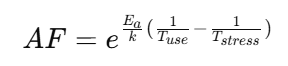
Where:
- Ea = activation energy
- k = Boltzmann constant
- T = temperature
2. Vibration Stress
Failure Mechanisms:
- Mechanical fatigue
- Loosening of joints
- Crack propagation
4.3 ALT Strategy
Step-by-step:
- Define mission profile
- Select dominant stress factors
- Increase stress levels (within physics-of-failure limits)
- Monitor failure modes
- Extrapolate to normal conditions
4.4 Engineering Insight
ALT is not about breaking components—it is about understanding how they fail.
5. Root Cause Analysis (RCA): Eliminating Failure Mechanisms
Once failures are identified through ALT or field data, the next step is RCA.
5.1 RCA Framework: 3M Approach
1. Material
Common Issues:
- Corrosion
- Fatigue
- Wear
- Degradation
2. Method
Examples:
- Incorrect installation
- Poor maintenance procedures
- Improper calibration
3. Machine (Design Weakness)
Examples:
- Stress concentration
- Inadequate cooling
- Undersized components
5.2 RCA Methods
- 5 Whys
- Fishbone Diagram
- Fault Tree Analysis (FTA)
- Failure Physics Analysis
5.3 Key Principle
Fixing symptoms improves reliability temporarily.
Eliminating root causes improves reliability permanently.
6. When Elimination Is Not Enough: Redundancy Architecture
Even after RCA and design improvements, some failures are unavoidable due to:
- Random failures (β ≈ 1)
- External disturbances
- Cost limitations
This leads to the need for architectural redundancy.
7. Parallel Systems: Reliability Enhancement Strategy
7.1 Basic Parallel Concept
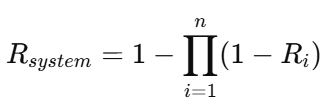
Parallel systems increase reliability because:
The system works as long as at least one component works.
7.2 Types of Redundancy
7.2.1 Active Redundancy
Characteristics:
- All units operate simultaneously
- Load is shared
Advantages:
- Immediate backup
- Improved performance
Disadvantages:
- Higher wear
- More complex balancing
7.2.2 Standby Redundancy
Types:
- Cold standby
- Warm standby
- Hot standby
Advantages:
- Reduced wear on backup unit
- Longer life
Disadvantages:
- Switching reliability required
- Detection delay risk
7.2.3 k-out-of-n Systems (Voting Logic)
Definition:
System works if at least k out of n components function.
Example:
- 2oo3 (2-out-of-3 voting)
Applications:
- Safety Instrumented Systems (SIS)
- Aerospace systems
7.3 Reliability Comparison
| Architecture | Reliability Impact | Cost | Complexity |
|---|---|---|---|
| Series | Low | Low | Low |
| Parallel | High | Medium | Medium |
| Standby | High | Medium | High |
| k-out-of-n | Very High | High | High |
8. Integrated Strategy: From Weakest Component to Robust System
Step-by-Step Engineering Workflow
Step 1: Identify Weak Component
- Use failure data
- Perform Weibull analysis
Step 2: Apply ALT
- Identify failure physics
- Validate failure modes
Step 3: Conduct RCA
- Eliminate design/material/process issues
Step 4: Recalculate Reliability
- Validate improvement
Step 5: Add Redundancy (if needed)
- Select architecture based on risk and cost
9. Case Study Example (Industrial Perspective)
System:
Gas compression system with multiple subsystems in series.
Problem:
Frequent shutdown due to sensor failure.
Analysis:
Step 1:
- Sensor reliability = 0.92 (weakest component)
Step 2:
- ALT reveals thermal degradation
Step 3:
- RCA identifies: Poor heat dissipation (design weakness)
Step 4:
- Redesign housing → reliability improves to 0.97
Step 5:
- Add 2oo3 voting sensors
Result:
- System reliability significantly increased
- Reduced nuisance trips
10. Economic Perspective
Trade-off Analysis
Improving reliability has cost implications:
- ALT cost
- Redesign cost
- Redundancy cost
Decision Rule:
Invest in redesign when failure is systematic
Invest in redundancy when failure is random or unavoidable
11. Key Engineering Principles
1. Weakest Link Principle
System reliability is dictated by the least reliable component.
2. Physics of Failure
Understand why failure occurs, not just when.
3. Design Out Failure First
Always prioritize elimination over compensation.
4. Redundancy as Last Defense
Use redundancy strategically—not blindly.
12. Conclusion
Reliability engineering is not about increasing average performance—it is about eliminating failure pathways.
The Reliability Component Architecture approach provides a structured way to:
- Identify weak components
- Understand failure mechanisms
- Eliminate root causes
- Reinforce system through redundancy
In series systems, this approach is critical because:
One failure is all it takes.
Therefore, the path to high reliability is not linear—it is hierarchical:
- Find the weakest link
- Understand why it fails
- Eliminate the cause
- Protect the system with architecture
Final Thought
In engineering systems, reliability is not an attribute—it is a designed outcome.
And that design begins by asking one fundamental question:
Where is the weakest component—and why does it fail?

Maintenance, projects, and engineering professionals with more than 15 years experience working on power plants, oil and gas drilling, renewable energy, manufacturing, and chemical process plants industries.